



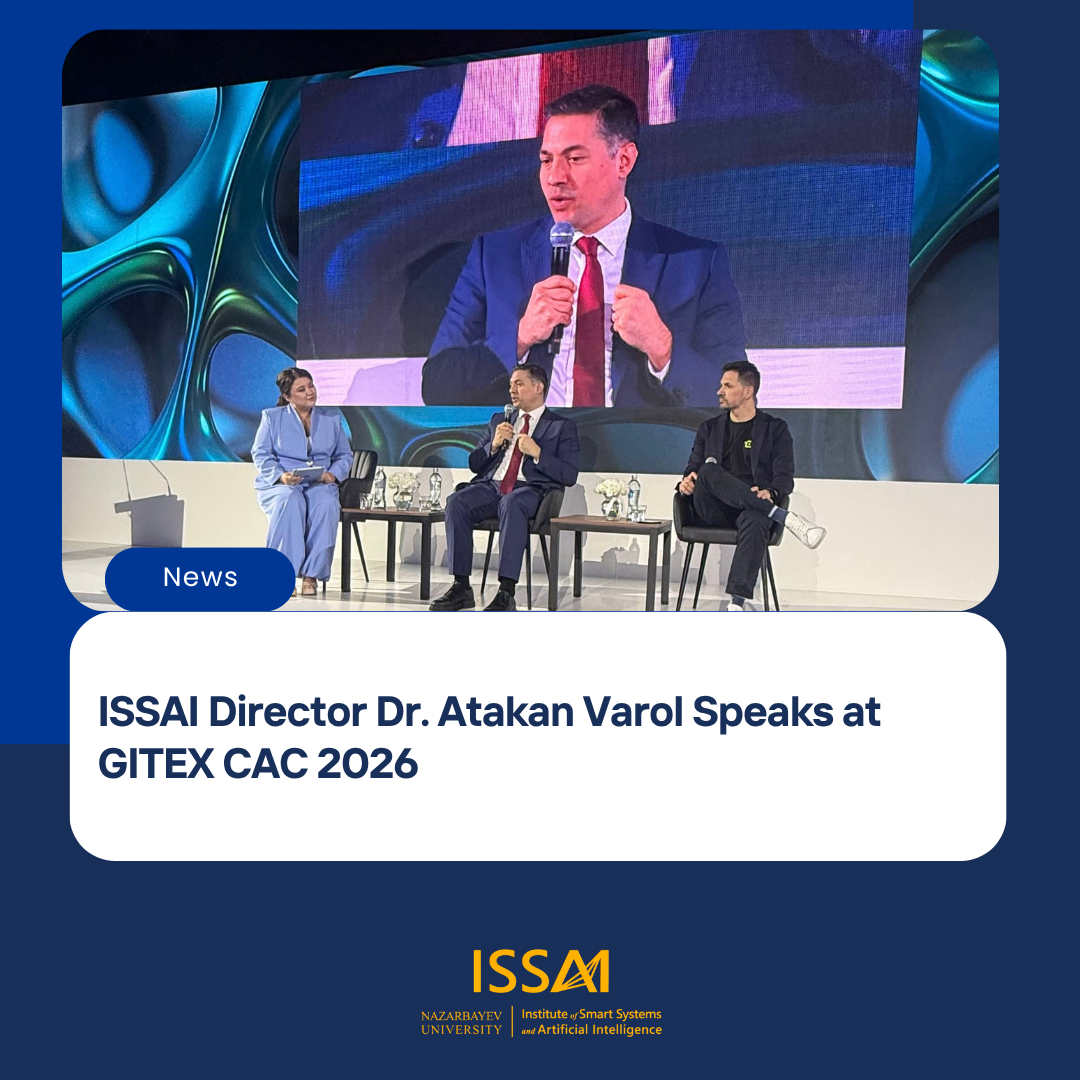
On May 4-5, 2026, Dr. Huseyin Atakan Varol, Founding Director of the Institute of Smart Systems and Artificial Intelligence (ISSAI), participated in GITEX Central Asia and Caucasus 2026, one of the world’s leading platforms for technology and innovation. ISSAI extends its sincere appreciation to the GITEX organizers, the Almaty Akimat, and the Ministry of Artificial Intelligence and Digital Development of the Republic of Kazakhstan for hosting and supporting this important event.
On May 5, Dr. Varol joined the panel discussion “Scaling Sovereign AI: Policy, Capital & Economics” at the AI Stage, moderated by Aida Haidar, Head of News Department and Business Editor at The Astana Times, alongside Oleksii Sharavar, Chief Executive Officer of QazCode. The discussion focused on sovereign data strategies and cross-border digital collaboration. During the session, Dr. Varol emphasized that sovereign AI should not be viewed as isolation, but rather as a strategic ecosystem combining infrastructure, governance, education, and international partnerships. He also addressed the realities for mid-sized economies, stressing the importance of focusing on high-value niche areas where countries like Kazakhstan can achieve global competitiveness. He further underlined the need to balance strong data protection with openness to ensure local languages and cultures are represented in global AI systems.
Later that day, Dr. Varol participated in a fireside chat on the NXT Stage titled “AI-Powered Education & Human Capital Transformation,” alongside Richard Stirling, Co-Founder and Chief Executive Officer of Oxford Insights, and with moderator Kris Wadia, Founder of Tech Emirates Advocates. The discussion explored how countries can scale AI adoption responsibly while ensuring inclusive workforce transformation. Dr. Varol highlighted Kazakhstan’s progress in embedding AI ethics, data protection, and academic integrity into its national education framework, positioning the country as a regional pioneer. He emphasized that successful implementation requires strong alignment between policy, education, and technology, as well as large-scale investment in educator capacity and AI literacy.
He also noted that countries must proactively shape public perception of AI, emphasizing its role as a driver of opportunity and growth. In this regard, he highlighted the importance of global platforms such as GITEX in fostering dialogue and building confidence in AI technologies.