



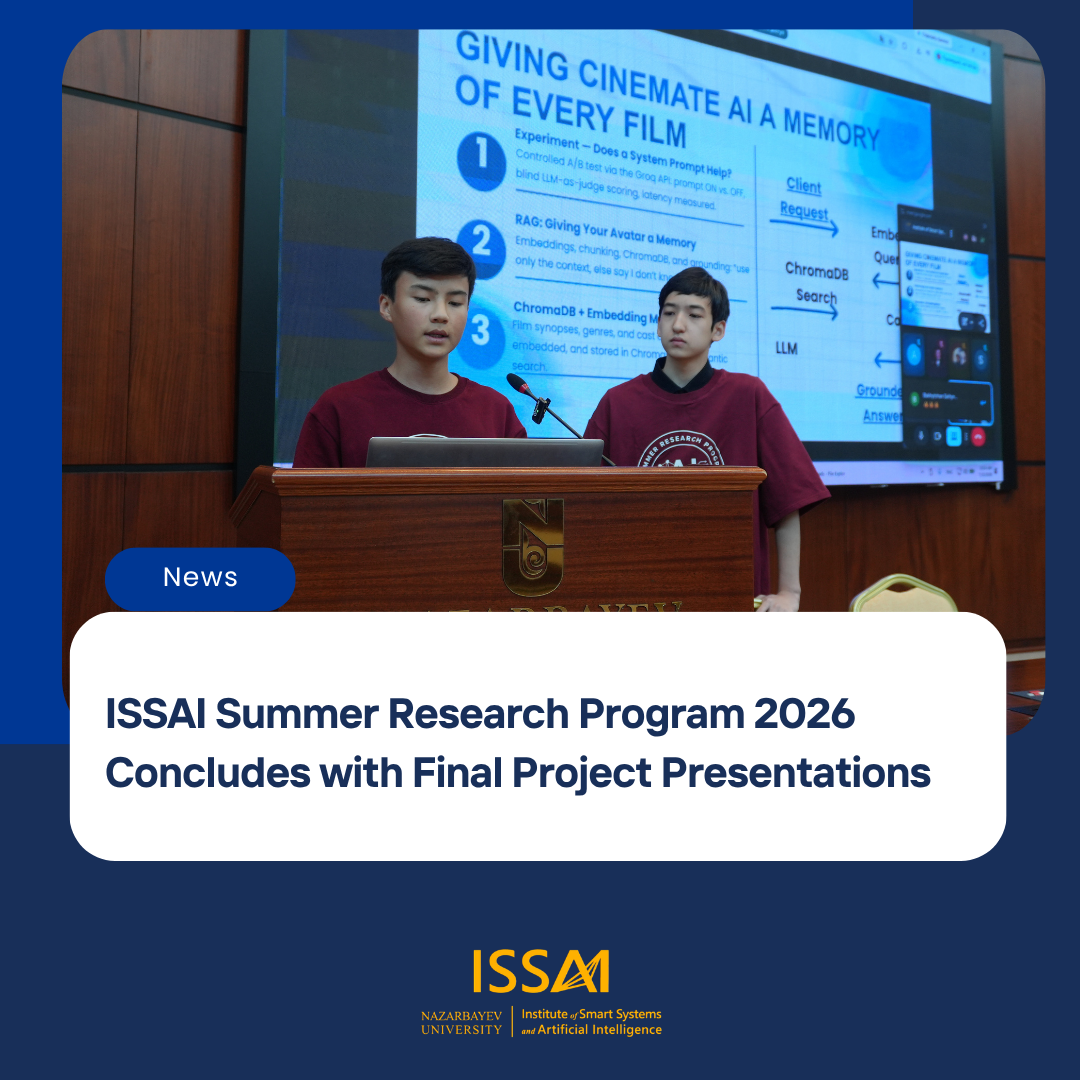
On July 15, 2026, the final project presentations of the ISSAI Summer Research Program took place at Senate Hall, Nazarbayev University, marking the completion of an intensive six-week research journey.
During the event, participants presented the results of the projects they had developed under the guidance of ISSAI mentors, including researchers, developers, and data analysts. The presentations demonstrated the knowledge and practical skills acquired throughout the program, as well as the participants’ ability to apply artificial intelligence technologies to real-world challenges.
The event opened with welcoming remarks by Dr. Atakan Varol, Founding Director of ISSAI. In his speech, Professor Varol noted that ISSAI received more than 1200 applications from talented high-school and university students this year. Following a highly competitive selection process, 77 participants were invited to join the program. The cohort brought together high-school students from Kazakhstan, Kyrgyzstan, and Armenia, as well as university students representing institutions in Kazakhstan and Europe. Professor Varol reflected on the scale and achievements of this year’s program: “Beyond the numbers, what matters most is something that cannot be measured: the multitude of new ideas you explored, the countless skills you developed, the friendships and professional networks you built, and the invaluable experience you gained.”
Participants joined the program from a wide range of schools and universities, including Spectrum International School, Quantum TECH School, Quantum STEM School, Haileybury Astana, Oxford International School in Bishkek, Nurorda School, Prometheus School, Shoqan Walikhanov Private School, Astana Bilim Innovation Lyceum for Gifted Girls and Bilim Innovation Lyceum for Boys from different cities across the country, the National School of Physics and Mathematics, Nazarbayev Intellectual Schools, as well as university students from IITU, KBTU, Nazarbayev University, LUISS University, Italy and many others.
The participants worked across several research tracks covering some of the most dynamic areas of modern artificial intelligence: Building AI Avatars, Audio-Visual Models, Audio-Visual Speech Recognition, AI Agents, Mobile Applications, Software Engineering and Robotics. During the final presentations, participants showcased a diverse range of projects developed over the six-week program under the guidance of Mentors:
Track: AI Avatars
Mentor: Auyeskhan Alibekov
Project: AI Steam Game Advisor
Participants: Alimkhan Amanhzolov, Mukhammed Abdullaev
Project: Cinemate: Build a Web AI Avatar That Recommends Films
Participants: Dastan Kubanychbekov, Yerulan Meiirkhan
Project: AI Avatar: Virtual Learning Platform
Participant: Kausar Nurgali
Track: Audio-Visual Models
Mentor: Anuar Aryngazin
Project: Constructing an Annotated Kazakh Speech Dataset
Participants: Assylay Tabyldy, Nurislam Kuanyshev, Adiya Yessen, Dinmukhammed Yntykbay, Nurdaulet Turat, Beknur Ualikhanuly
Track: Audio-Visual Recognition
Mentors: Rakhat Meiramov, Adema Sharipova
Project: Kazakh–Russian Sign Language to Speech
Participants: Ali Bidanov, Aisanat Bektai, Alikhan Mukangaliyev, Asan Tasmulaev, Zhoshy Khalelov, Adilet Tasbolat, Azamat Tasbolatov, Seymur Aghayev
Track: AI Agents
Mentors: Akylbek Maxutov, Nartay Aikyn
Project: Gambit: In-Match Tactical Analysis and Counterfactuals
Participant: Akylzhan Alin
Project: Evaluating VLMs as Judges
Participant: Artur Karnakbayev
Project: CultureFix — Fixing Cultural Errors in AI-Generated Images with Image Retrieval
Participant: Zhasulan Oraz
Project: Does Answer Order Change the Answer? Measuring Position Bias in LLMs
Participant: Zhaniya Bostibay
Project: Echo — Same Question, Different Words: Are LLMs Robust to Paraphrasing?
Participant: Aisha Tazhibakhyt
Project: Chaff — Can LLMs Ignore Noise? Testing Robustness to Irrelevant Information
Participant: Sulu Saurykova
Project: Veneer — How Much Is in the Prompt?
Participant: Adiya Mukhambetzhan
Project: Project Title to Be Confirmed
Participant: Zhamilya Duisebek
Project: Blueprint — An Agent That Generates Images with a Structured Layout Plan
Participant: Dastan Nureden
Project: Iterative AI Agent for Image Generation and Improvement
Participant: Daniil Svetlov
Project: StoryCut — From One Idea to a Storyboard of Keyframes
Participant: Amir Zakirzyanov
Project: Oracle — Can AI Predict Football and Know When It Is Just Guessing?
Participant: Alikhan Kassen
Project: PlanLens — Diagnosing Structural Planning Failures in AI Agents
Participant: Nurdaulet Abdrakhman
Project: Trajectory-Level Trust Scoring for AI Agents
Participant: Daniyal Kozyrev
Project: FactCheck — Post-Match Analysis Faithfulness
Participant: Aidar Suanbek
Project: Replay — Image-Based Incident Understanding
Participant: Erasyl Magauya
Project: Heatmap — In-Match Player Performance Analysis
Participant: Jaleel Gabitov
Project: Live-xG — Sequential Probability Tracking Benchmark
Participant: Alikhan Islambek
Project: StyleLock — Can an Agent Make Visual Style Consistent?
Participant: Ramazan Zhanuzak
Project: Pulse — In-Play Match Reasoning
Participant: Abay Atazhan
Track: AI Agents
Mentor: Mamyrbek Parakhat
Project: Adapting OmniVoice to Kazakh While Improving Speech Quality and Voice Controllability
Participant: Shyngys Sovetkhan
Project: FP4-Speech — Hardware-Based 4-Bit Inference for Speech Models on NVIDIA Platforms
Participant: Arnur Yembergen
Track: Mobile Applications
Mentor: Akjan Yerkin
Project: CozyStudy — A Mobile Application for Study Planning and Productivity
Participant: Samira Duanbaeva
Project: ZhanUNI — Solving the Research Chaos
Participant: Mariyam Yelemes
Project: EcoGuest
Participant: Ayliz Omurzakova
Project: PlaniX
Participant: Gauhar Bissembay
Project: Bastau App — AI Startup Incubator
Participant: Almansur Tolepbergenov
Project: Finwise — A Gamified Mobile App Teaching Children and Teenagers How to Manage Money in Kazakh, Russian, and English
Participant: Asanali Sabyrzhan
Project: GLOW — A Mobile Application for Study Planning and Productivity
Participant: Madiyar Adilbek
Project: Cashexx — The Future of Frictionless Financial Intelligence
Participant: Magzhan Yessengeldi
Project: Pandu — Mobile Skincare Companion
Participant: Anri Zhan
Track: Software Engineering
Mentors: Nazira Sabyraly, Alar Akilbekov
Project: JolFix
Participant: Nazym Sankibay
Project: Bookly Site Presentation
Participant: Yertay Jandarbek
Project: SentrySite AI
Participant: Berdykhan Turdykhan
Project: Project Title to Be Confirmed
Participant: Aibike Nurakhan
Project: TalentAI
Participant: Zhasmin Zhussipkyzy
Project: Tender AI
Participant: Bogdan Glazkov
Project: Games Browser
Participant: Iaroslav Babutin
Project: CityHelper AI — Next-Generation Conversational Smart City Navigation Platform
Participant: Taubek Smagulov
Project: AI PC Build Assistant
Participant: Maxim Yagmurov
Project: DebateHelp
Participant: Abish Abdikalikov
Track: Robotics
Mentors: Gourav Deppa, Dias Akimbay
Project: Manipulator for Educational Purposes
Participants: Nuray Makuova, Zhaniya Kaliyeva, Aruzhan Kuandyk
Project: Building a Drone Quadcopter
Participants: Yerassyl Berdybek, Vitali Courtney, Beren Murat, Maxim Danilkin
Project: Design and Simulation of a 4-DOF Manipulator with a Soft Gripper
Participants: Daniil Yanson, Iskander Rakhmatullin, Targyn Faizulla, Serzhan Kadylbek, Shynggys Galymuly, Aldiyar Tolegen
Project: Soft Robotics
Participants: Tair Mukashev, Sabina Umirzhanova, Amirkhan Kaliyev, Aldiyar Almenov
Over the course of six weeks, participants attended theoretical lectures, masterclasses, workshops, and seven guest lectures delivered by experts from academia and industry. They also took part in three industry visits, including excursions to Astana Hub and the Nazarbayev University Technopark, where they had an opportunity to learn more about Kazakhstan’s growing innovation ecosystem and meet representatives of technology companies and startups.
The final presentations were attended by participants’ parents, ISSAI representatives, and professors and faculty members of Nazarbayev University, while several parents also joined the event online. Members of the audience highlighted the participants’ strong level of preparation and the quality of the presented projects.
The program welcomed students with different levels of prior experience. While some participants joined with an established background in programming and artificial intelligence, others began the program with limited or no programming experience. Despite these differences, every participant successfully completed the program, contributed to a research project, and presented their results before the audience.
ISSAI expresses its sincere gratitude to all participants for their enthusiasm, dedication, and hard work, as well as to the mentors who supported and guided them throughout the program.
We congratulate the participants on completing the ISSAI Summer Research Program 2026 and wish them every success in their future studies, research projects, presentations, and professional endeavors.