


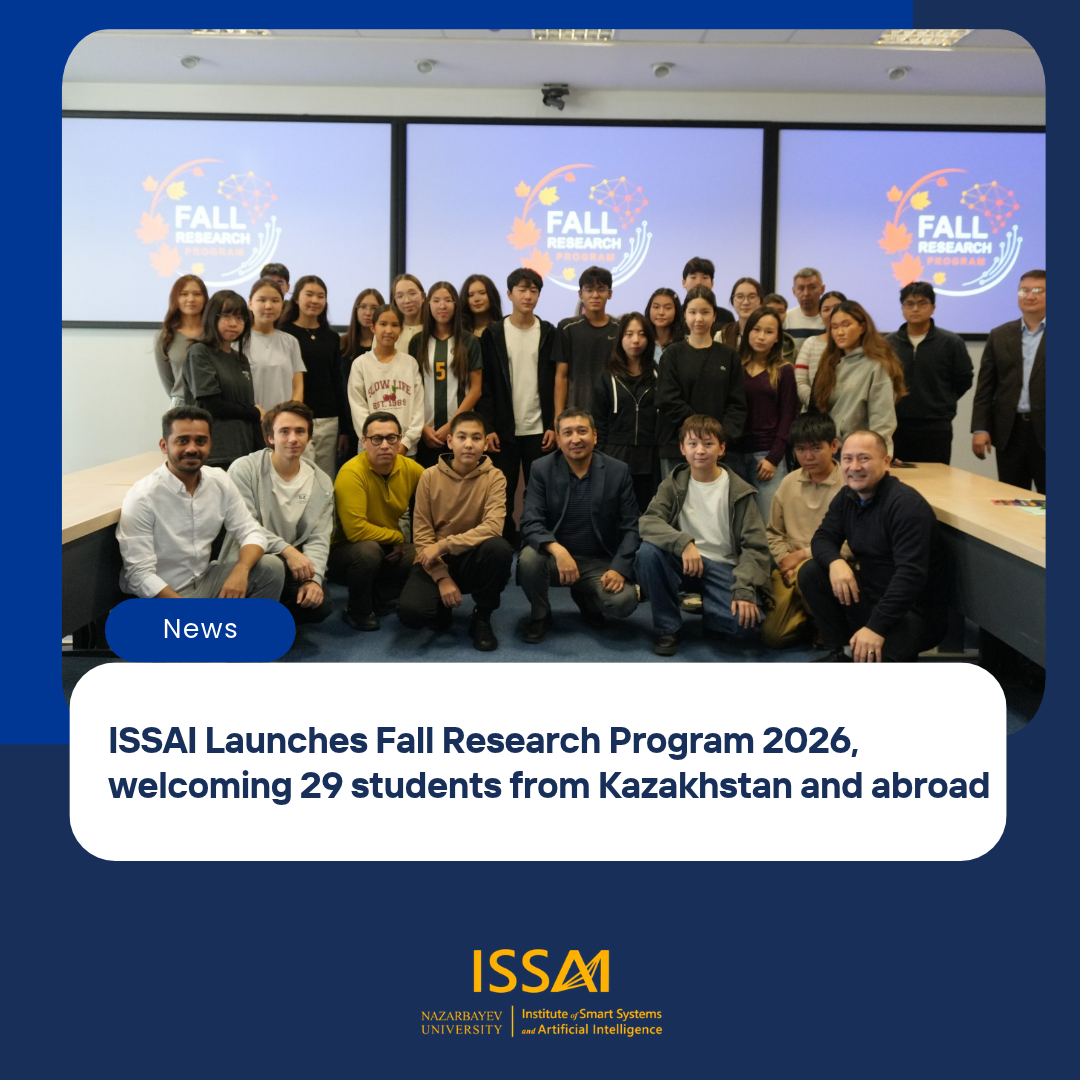
On October 24, 2026, the Institute of Smart Systems and Artificial Intelligence (ISSAI) at Nazarbayev University officially launched the ISSAI Fall Research Program (FRP) 2026. Building on the success of its Summer Research Programs, held annually since 2021 and attracting over 5,000 applications and more than 200 participants, ISSAI decided to expand its educational initiatives by introducing the FRP. Designed as a more intensive and interdisciplinary eight-day program, FRP offers high school students a unique opportunity to gain hands-on experience and immerse themselves in the exciting fields of artificial intelligence and robotics during their autumn school break.
The program welcomes 29 talented and motivated students from various schools across Kazakhstan and abroad, including participants from Astana, Almaty, Shymkent, Taraz, Kostanay, Pavlodar, Atyrau, Kyzylorda, the Zhambyl region, and Manila. Nearly half of the participants have traveled from outside Astana to take part in this unique research experience. The participants represent a diverse range of educational institutions, including Nazarbayev Intellectual Schools (NIS), Bilim Innovation Lyceums (BIL), Republican Physics and Mathematics Schools (RFMS), Spectrum International School, Riviera International School, Astana Garden School, Canadian International School Astana, International School Manila, and other leading schools.
Hosted at ISSAI’s research facilities on the Nazarbayev University campus, the program provides students with an opportunity to experience a professional research environment, gain hands-on technical skills, and work directly with ISSAI researchers and engineers.
The program officially began with a welcoming address by ISSAI Executive Director Yerbol Absalyamov, who greeted the participants and wished them a productive and inspiring research experience. ISSAI mentors – Dr. Gourav Moger, Researcher, Vladimir Albrekht, and Arailym Raikhankyzy, Data Scientists at ISSAI, introduced themselves and presented the program syllabi, outlining the research activities, learning objectives, and projects awaiting students over the eight days. Participants and their parents also had the opportunity to ask questions and learn more about the program. The opening day included a campus tour of the Nazarbayev University and ISSAI research laboratories, allowing students to explore the facilities and research environment where they will spend the coming days.
During Fall Research Program, ISSAI has introduced two specialized tracks: AI Engineering and Robotics, carefully designed to reflect the interests, educational backgrounds, and preferences of applicants. Both tracks combine theoretical knowledge with intensive practical training, allowing students to explore advanced technologies and develop their own research projects under the guidance of experienced mentors.
The AI Engineering track introduces students to the technologies behind modern artificial intelligence, including large language models, AI agents, speech recognition, speech synthesis, and computer vision. Participants will gain hands-on experience working with ISSAI’s high-performance computing infrastructure, including a DGX server equipped with 16 GPUs, and explore AI models developed at ISSAI, including those designed for the Kazakh language. Throughout the program, students will learn how AI models are trained, evaluated, and applied to real-world challenges. Using AI-assisted development tools, they will design and build their own AI-powered applications, conduct experiments, evaluate results, and prepare research reports. By the end of the program, each participant is expected to present a working AI project, supported by a GitHub portfolio and a dedicated project webpage.
The Robotics track focuses on the practical foundations of robotic system development, combining mechanical design, electronics, programming, and intelligent control systems. Students will learn to create 3D models using SolidWorks, work with Arduino microcontrollers, integrate sensors and actuators, and explore the principles of robotic motion and automation. Following the introductory training, participants will work on practical robotics projects involving Crazyflie educational quadcopters, soft continuum robots, or robotic arm manipulators, depending on their selected project and technical background. Through hands-on development, testing, and experimentation, students will gain valuable experience in designing, programming, and operating robotic systems.
Both tracks will conclude on October 31 with a final Demo Day, during which participants will present their projects, demonstrate their technical achievements, and share the knowledge and skills acquired throughout the program.
Beyond technical training, the ISSAI Fall Research Program aims to inspire young people to pursue careers in artificial intelligence, robotics, engineering, and scientific research. By providing early exposure to advanced technologies and a professional research environment, the initiative encourages students to develop critical thinking, creativity, problem-solving skills, and an interest in technological innovation.
Through educational initiatives such as the Summer Research Program and Fall Research Program, ISSAI continues to create meaningful opportunities for talented students to explore emerging technologies, engage with researchers, and take their first steps toward becoming the next generation of AI scientists and engineers.