



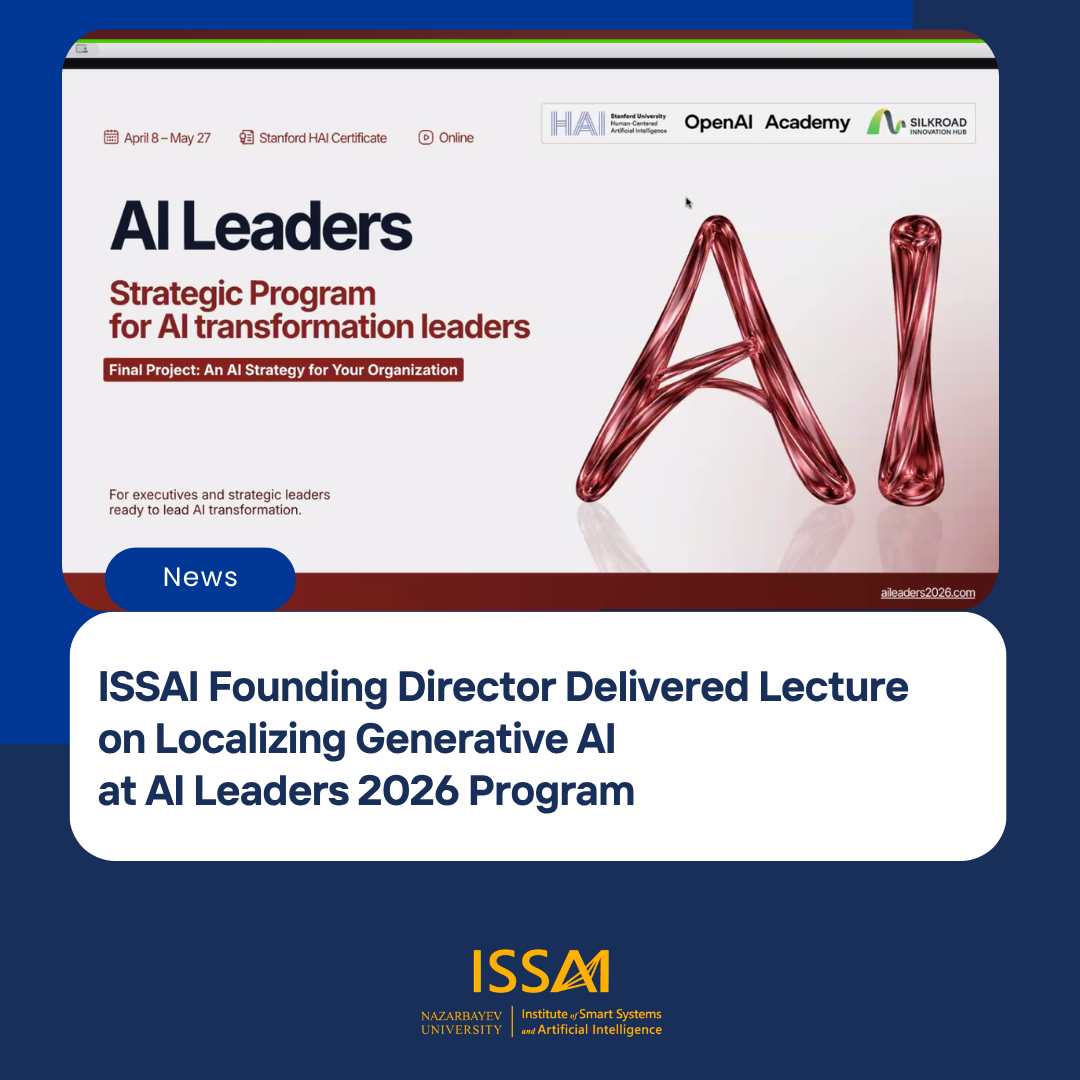
On May 12, 2026, Huseyin Atakan Varol, Founding Director of the Institute of Smart Systems and Artificial Intelligence (ISSAI), delivered an online lecture titled “Localizing Generative AI: Practical Deployment in Resource-Constrained Environments” as part of the international AI Leaders 2026 program.
AI Leaders 2026 is an eight-week strategic educational program for AI transformation leaders organized by Stanford Human-Centered Artificial Intelligence, OpenAI Academy, Silkroad Innovation Hub, Lovable, and CAYU. Held online from April 8 to May 31, 2026, the program brought together leaders, executives, and decision-makers working at the intersection of technology, management, and strategic transformation.
The curriculum included Stanford HAI academic lectures, OpenAI Academy practical sessions, hands-on workshops on AI applications without coding, and agentic AI development modules. The program featured lectures by leading international experts from Stanford University and other institutions, including Peter Norvig, Michael Bernstein, Arvind Karunakaran, Tatsunori Hashimoto, Alex Pentland, Mykel Kochenderfer, Angela Aristidou, and Diyi Yang.
In his lecture, Prof. Varol discussed the growing importance of localized and sovereign generative AI systems for countries and regions with lower-resource languages and unique cultural contexts. He emphasized that while frontier AI models are rapidly advancing globally, many regions remain underrepresented in AI ecosystems and require locally adapted solutions tailored to their linguistic, cultural, and regulatory needs.
The presentation highlighted ISSAI’s achievements in generative AI research and development, including the creation of KAZ-LLM, Kazakhstan’s large language model optimized for Kazakh, Russian, and English, as well as multimodal AI systems such as Oylan and Qolda. Participants were introduced to ISSAI’s work in developing open-source datasets, speech technologies, translation systems, multimodal reasoning models, and AI products tailored specifically for Kazakhstan and Central Asia.
The lecture also explored practical aspects of generative AI deployment, including GPU computing infrastructure, data centers, cloud and edge computing, latency, data sovereignty, and localized inference systems. Through real-world case studies from healthcare, banking, education, mining, and industrial sectors, Prof. Varol demonstrated different strategies organizations can use to deploy AI solutions depending on their privacy requirements, infrastructure limitations, and operational goals.
Particular attention was given to the importance of open-source AI ecosystems, local data generation, and the development of domestic AI expertise and infrastructure. The session emphasized that localized AI systems can help countries strengthen digital sovereignty, improve language representation, and create AI solutions aligned with local societal and economic needs.
AI Leaders 2026 combines academic content, practical AI implementation training, case study analysis, and hands-on workshops designed to help leaders integrate AI into organizational workflows and strategic decision-making processes.