

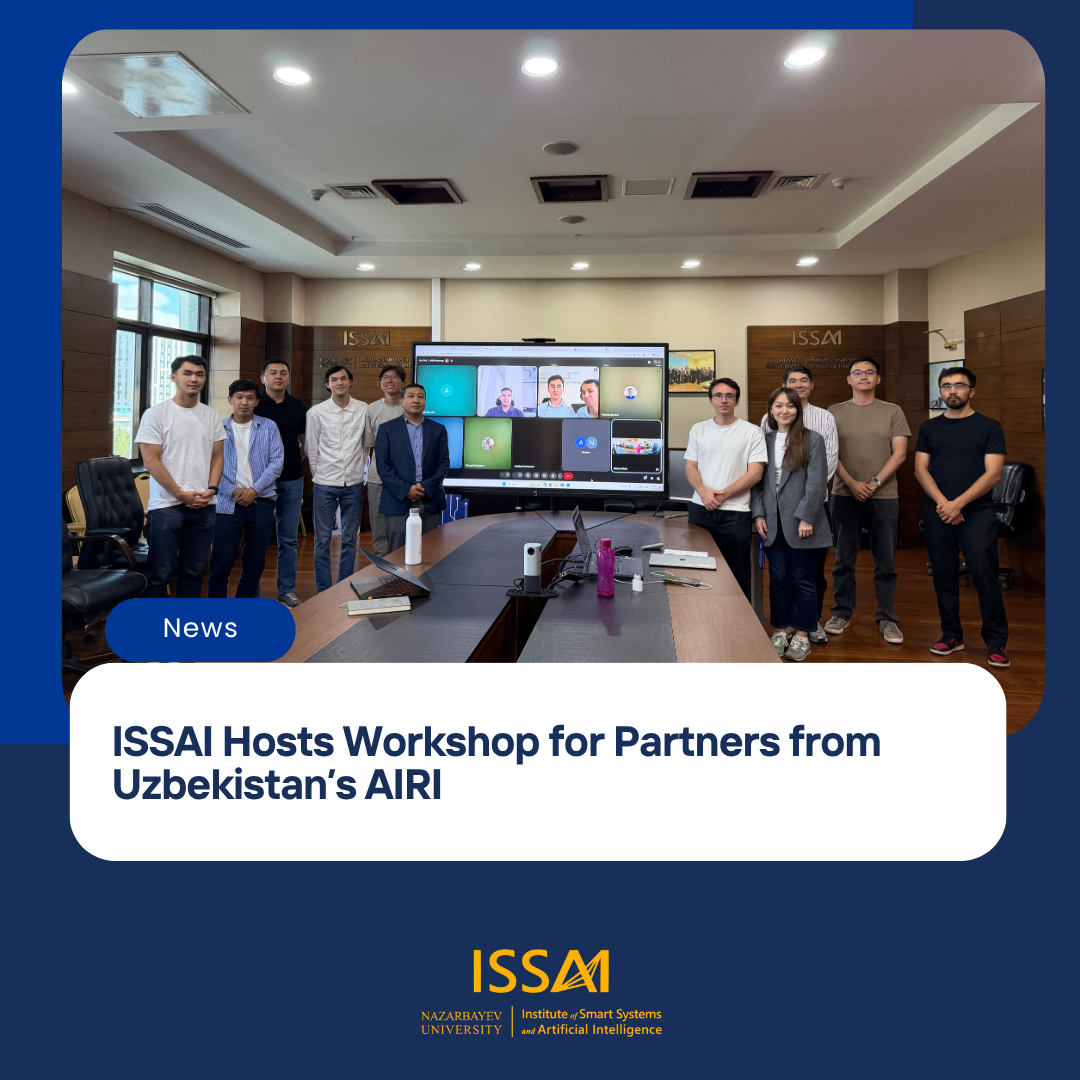
On August 18, 2026, the Institute of Smart Systems and Artificial Intelligence (ISSAI) at Nazarbayev University hosted an online workshop for its partners from the Digital Technologies and Artificial Intelligence Development Research Institute (AIRI) of Uzbekistan.
The workshop followed the Memorandum of Understanding signed between ISSAI and AIRI during ISSAI Connect in July, marking another step toward strengthening cooperation between the two organisations in artificial intelligence research and knowledge exchange.
During the workshop, ISSAI researchers presented their work and shared practical insights into the development, training, and evaluation of AI models for low-resource languages.
Lead Data Scientist Askat Kuzdeuov delivered a presentation on “Development of Expressive Text-to-Speech with Non-Verbal Vocalizations for a Low-Resource Language,” focusing on approaches to creating more expressive and natural speech synthesis.
Data Scientist Anuar Aryngazin presented “Development of Generic Text-to-Speech for a Low-Resource Language,” discussing the development of text-to-speech technologies for languages with limited available resources.
Data Scientist Vladimir Albrekht spoke on “How to Train LLMs and VLMs on a Multi-Node, Multi-GPU Cluster,” providing insights into the infrastructure and training processes required for large-scale language and vision-language models.
Senior Data Scientist Akylbek Maxutov delivered a presentation titled “How to Create LLM and VLM Benchmarks for a Low-Resource Language,” highlighting approaches to evaluating language and vision-language models in low-resource linguistic settings.
The workshop provided a platform for researchers from ISSAI and AIRI to exchange expertise, discuss current challenges, and explore opportunities for further joint research. The event also laid the groundwork for continued knowledge sharing and collaboration between the two institutions, building on the partnership established through the July memorandum.
ISSAI and AIRI look forward to further strengthening their cooperation through joint research initiatives, technical knowledge exchange, and future academic and professional activities in the field of artificial intelligence.