

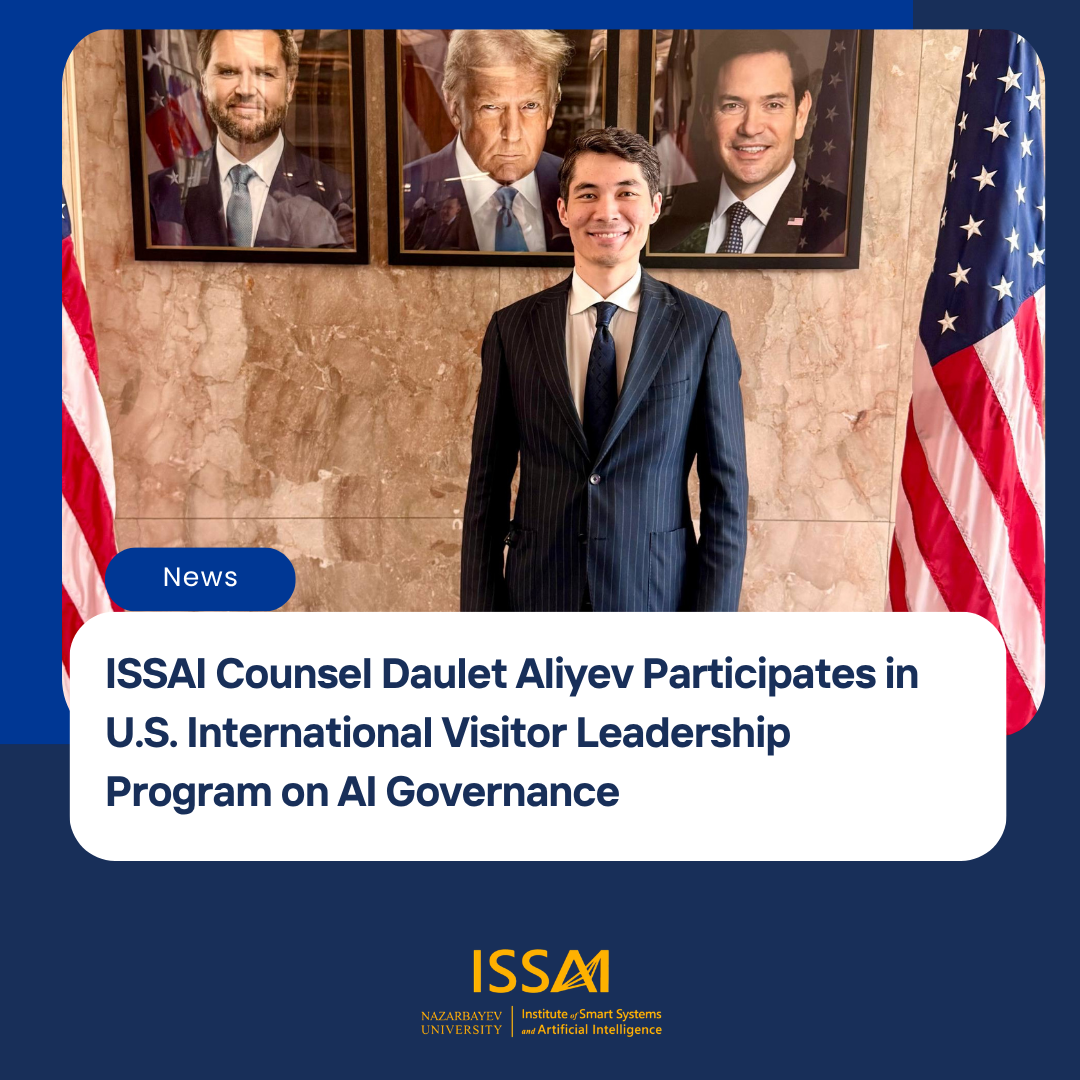
From June 7 to June 28, 2026, Institute of Smart Systems and Artificial Intelligence (ISSAI) Counsel Daulet Aliyev participated in the International Visitor Leadership Program (IVLP), titled “Artificial Intelligence: U.S. Approaches to Regulation and Global Cooperation.”
The three-week program brought together international professionals to explore U.S. approaches to artificial intelligence governance, regulation, cybersecurity, and innovation. The itinerary included visits to Washington, D.C., Louisville (Kentucky), Phoenix (Arizona), and Dallas (Texas), where participants engaged with representatives of government institutions, legislators, academia, technology companies, and public policy experts.
During the program, Daulet took part in discussions on AI legislation, responsible AI, cybersecurity, and the use of AI in the public sector. Highlights included meetings with Nick Kupper and Justin Wilmeth, members of the Arizona House of Representatives, who shared perspectives on legislative approaches to AI, a cybersecurity session led by Cyrus Mousavi, PayPal Cloud Security Oversight Principal, and a meeting with Eugene Mejia, Chief Information Officer for the Town of Gilbert, on the integration of AI into municipal services.
The program also featured discussions on responsible AI implementation with Assel Kaliyeva and Kathryn Harpool of PwC in Dallas, focusing on practical approaches to embedding Responsible AI principles within organizations.
A key takeaway from the program was the NIST AI Risk Management Framework, which provides a practical, risk-based approach to the development and deployment of trustworthy AI systems. The framework offers valuable guidance for identifying, assessing, and managing AI-related risks while supporting innovation. ISSAI will continue exploring international best practices in AI governance and opportunities to incorporate relevant frameworks into its research and policy initiatives.
Participation in the IVLP strengthened ISSAI’s engagement with the international AI policy community and provided valuable insights into governance approaches at the federal, state, and local levels in the United States. The program also created new opportunities for knowledge exchange and future collaboration on responsible and trustworthy artificial intelligence.
ISSAI extends its sincere gratitude to the U.S. Embassy in Kazakhstan, the U.S. Department of State’s Bureau of Educational and Cultural Affairs (ECA), Cultural Vistas, the World Affairs Council of Kentucky and Southern Indiana, Global Ties Arizona, and the World Affairs Council of Dallas/Fort Worth for organizing this valuable professional exchange program.