



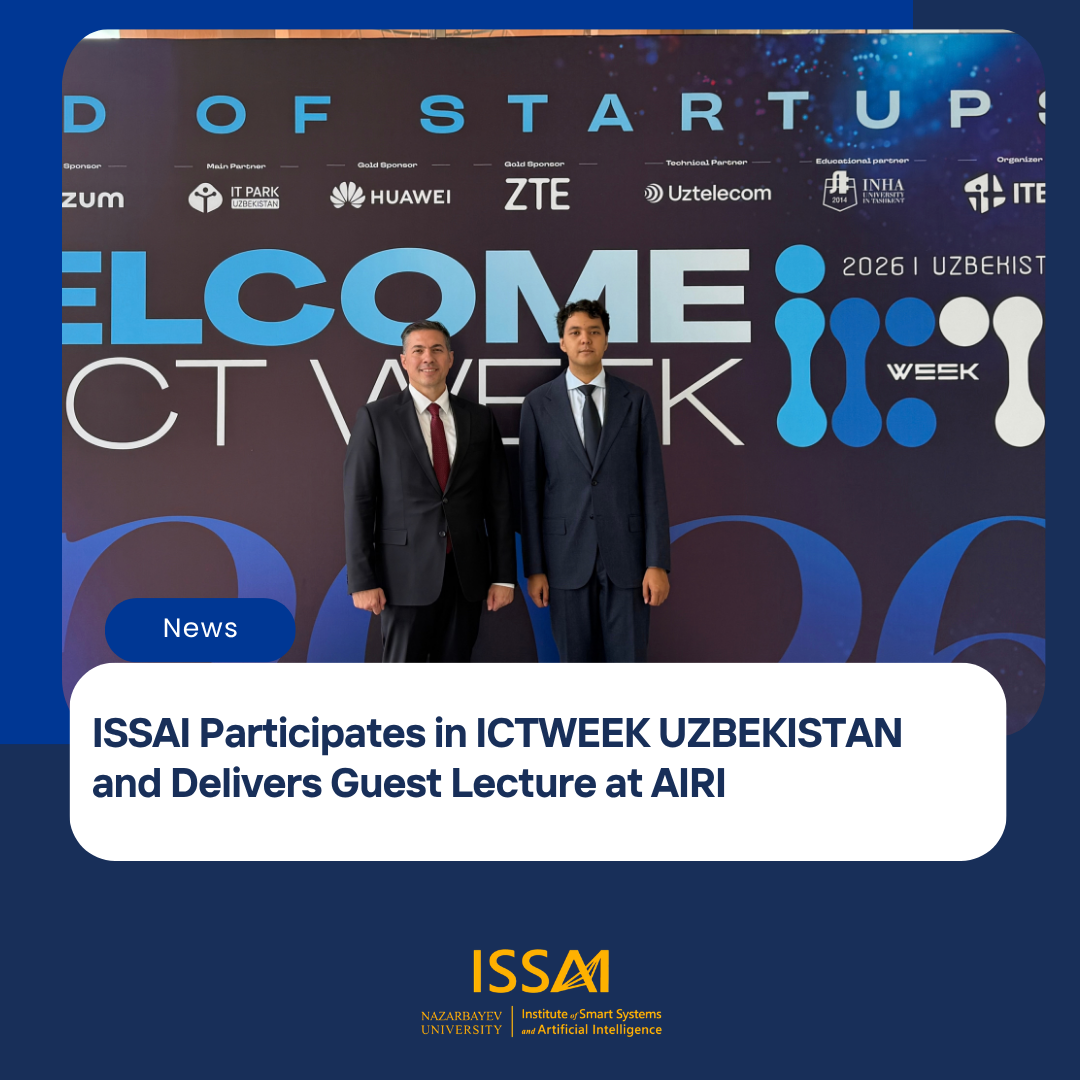
On September 23, 2026, the Institute of Smart Systems and Artificial Intelligence (ISSAI) at Nazarbayev University participated in ICT Week Uzbekistan 2026 Forum in Tashkent, Uzbekistan.
ICT Week Uzbekistan 2026, held on September 22–25, is an annual international event that brings together technology companies, researchers, industry experts, startups, and representatives of the public sector. The event serves as a platform for sharing expertise, showcasing technological developments, and discussing innovation and digital transformation. The 2026 program includes forums, summits, and the ICT Expo exhibition.
As part of the forum, Dr. Huseyin Atakan Varol, Dean of the School of Computing and AI and Founding Director of ISSAI, Nazarvayev University, participated as a speaker in the AI Ethics Forum: Shaping the Future of Responsible AI, held under the auspices of UNESCO.
The panel session was moderated by Aziz Atabekov, Vice Director of ZTE Uzbekistan, and brought together Marc-Antoine Dilhac, Professor at the University of Montreal and UNESCO AI Ethics Expert; Pablo Fuentes Nettel, Principal Consultant at Oxford Insights; Maria Bolshakova, Deputy Director General at the Regional Commonwealth in the Field of Communications; Ismail Malikov, Public Innovation and Technology Governance Analyst at AI Association Azerbaijan; and Professor Atakan Varol. The discussion focused on responsible AI development, ethical assessment, governance, data protection, and the role of AI in supporting public-sector decision-making.
Marc-Antoine Dilhac highlighted the importance of assessment methodologies for evaluating AI systems at the country level and ethical impact assessments. He noted that such assessments should examine what an AI system is, what goals it is designed to achieve, and what potential ethical implications may arise from its use. He also emphasized the value of UNESCO’s AI assessment methodology as a practical framework for evaluating AI systems. Pablo Fuentes Nettel spoke about the importance of strong political and civil services in ensuring that AI can be effectively and responsibly integrated into public administration. He also noted that one of the advantages of AI is its potential to serve as a useful tool for decision-makers, supporting them in analyzing information and making informed decisions.
Professor Atakan Varol focused on the development of regional language models and the importance of locally developed small language models such as the Qolda model developed by ISSAI for the Kazakhstani context. He also emphasized that local AI models can help protect sensitive information by allowing data to be processed within a trusted local environment. This is particularly important when working with medical records, official documents, and other sensitive or politically significant information, where transferring data to external AI systems may create additional digital security risks. He also highlighted the importance of developing AI solutions that are adapted to the linguistic and technological needs of individual regions. It was a productive platform for exchanging expertise, sharing insights, and building valuable professional connections.
In the afternoon, ISSAI Data Scientist Rakhat Meiramov delivered a guest lecture at the Digital Technologies and Artificial Intelligence Development Research Institute under the Ministry of Digital Technologies of the Republic of Uzbekistan introducing ISSAI and presenting the Qolda* model. Qolda is an open-source multimodal AI family developed by ISSAI and designed for efficient on-device inference on laptops and smartphones without reliance on high-performance computing infrastructure. Its flagship 4B-parameter language-vision model supports Kazakh, Russian, and English and can process text and images, including document analysis, visual question answering, and image-text understanding. The Qolda family also includes Qolda-AVL, a series of 5B, 9B, and 34B audio-vision-language models capable of processing audio, images, and text in the three languages. The presentation generated strong interest among the audience and was followed by an active Q&A session, with participants raising numerous questions about Qolda, its capabilities, and potential applications. The lecture highlighted ISSAI’s research capabilities in joint grant execution and building sovereign AI models.
The ISSAI team also met with the Chief Data Officer of Ipak Yuli Bank, Bauyrzhan Aubakir, an NU Robotics alumnus, and discussed collaboration opportunities at the intersection of AI and finance.
Through its participation in ICT Week Uzbekistan 2026 and the guest lecture at Digital Technologies and Artificial Intelligence Development Research Institute, ISSAI shared its research and technological developments, collaboration between academic organizations on joint project execution and contributed to discussions on the responsible development, governance, security, and application of artificial intelligence.
* Qolda model – A model created by ISSAI under the grant funded by the Science Committee of the Ministry of Higher Education and Science of the Republic of Kazakhstan (program targeted funding – BR24993001), where consortium members are KazNU al-Farabi (leader), ISSAI, Til-Qazyna Scientific-practical center, Linguistic Institute named after A. Baitursynov, Institute of Information and Computational Technologies