


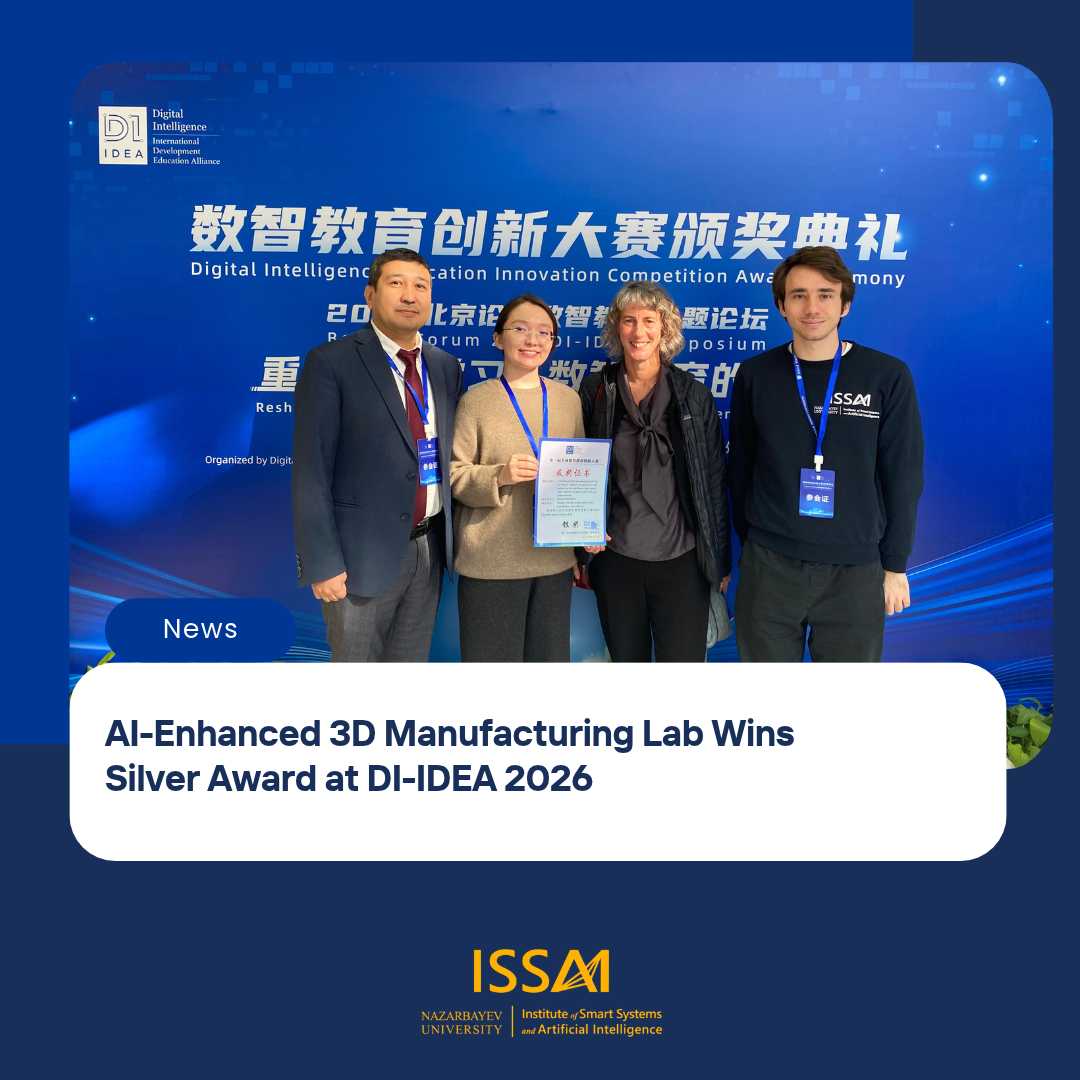
The Institute of Smart Systems and Artificial Intelligence (ISSAI) at Nazarbayev University has received a Silver Award at the 3rd Global Digital Intelligence Education Innovation Competition (DI-IDEA 2026) for its project, “AI-Enhanced 3D Manufacturing Lab.” The project was recognized in the AI-Enhanced Learning Innovation category under the AI for Teaching and Learning track.
The award was presented on November 8, 2026, during the competition’s award ceremony at Peking University in Beijing, China. ISSAI was represented at the ceremony by Dr. Zhanat Makhataeva, Senior Data Scientist, and Vladimir Albrekht, Data Scientist, who traveled to Beijing on behalf of the project team.
The ceremony was part of the Beijing Forum 2026 DI-IDEA Symposium, “Reshaping Human Learning: The Future of Digital Intelligence Education,” held from November 6 to 8. The international event brought together university leaders, researchers, and education experts to discuss how artificial intelligence and emerging technologies are shaping the future of teaching and learning.
Bringing Engineering Laboratories into the Digital World
The award-winning project transforms Nazarbayev University’s Intelligent Manufacturing Laboratory into an interactive virtual space that students can explore online.
Using 3D Gaussian Splatting (3DGS), an AI-based 3D reconstruction technique, the team created a digital replica of the laboratory’s Festo modular production system using just a video recorded on a smartphone.
Students can explore the virtual laboratory directly in their web browsers, examine the equipment, and interact with an AI-powered assistant. The assistant answers questions and explains how the manufacturing system works through text and synthesized speech. We aim to integrate our Qolda* model as the core of this AI-powered assistant, enabling intelligent and interactive support for students throughout their learning experience.
The project addresses an important challenge in engineering education: students do not always have direct access to specialized laboratory equipment. The virtual environment makes it possible to explore complex manufacturing systems remotely, without installing specialized software or using VR headsets.
Putting the Technology to the Test
To evaluate the learning experience, the team conducted a pilot study involving 15 Nazarbayev University students, including ISSAI research assistants. Participants explored the same manufacturing equipment in two formats: an interactive 3D environment and a traditional 2D presentation.
The results showed that participants achieved an average knowledge assessment score of 6.5 out of 8 in the 3D environment, compared with 5.7 in the 2D format. They also spent more time exploring the interactive environment, with a median exploration time of 344 seconds compared with 168 seconds in the 2D format.
Although preliminary, these findings offer encouraging insights into how interactive 3D environments could support engineering education by allowing students to explore equipment and learn at their own pace.
The team plans to expand the study, digitize additional laboratories, and explore 4D Gaussian Splatting to represent dynamic manufacturing processes in virtual environments.
ISSAI at the Beijing Forum 2026
The Beijing Forum 2026 provided an international platform for discussing the future of education in the age of artificial intelligence. The symposium featured university presidents, vice-provosts, researchers, and education experts from leading institutions across Asia, Europe, and North America.
Among the keynote speakers were Stefanie Lindstaedt, Founding President of the Interdisciplinary Transformation University Austria (Austria); Naeti Suksomboon, Vice President for Education at Mahidol University (Thailand); Tan Ooi Kiang, Deputy Provost (Education) at Nanyang Technological University (Singapore); and Rob Vanderlan, Executive Director of the Center for Teaching Innovation at Cornell University (United States).
A notable contribution from Nazarbayev University came from Samantha Smidt, Vice Provost for Academic Affairs, who delivered a keynote presentation titled “AI that Understands Kazakhstan’s Language and Culture – A Case Study from Nazarbayev University.” Her presentation highlighted the importance of developing AI technologies that understand local languages and cultural contexts, bringing Kazakhstan’s experience into the international discussion on AI in education.
The symposium also featured experts from University College London and the London School of Economics and Political Science (United Kingdom), Dublin City University (Ireland), The Hong Kong Polytechnic University and The University of Hong Kong (Hong Kong SAR), the University of Auckland (New Zealand), and the University of Michigan (United States).
Discussions throughout the forum focused on AI-enabled teaching and learning, the future of university education, academic innovation, and the changing role of educators in an increasingly digital world.
ISSAI was also represented at the forum by its Executive Director, Yerbol Absalyamov, who joined the international gathering of academic and education leaders.
The participation of ISSAI and Nazarbayev University representatives highlighted the University’s engagement in global discussions on digital education and the role of artificial intelligence in shaping future learning environments. Representatives from ISSAI actively discussed the potential implementation and practical applications of models such as Qolda* in services used by Chinese universities, while expressing their willingness to share their expertise and experience in this area.
Project Team and Acknowledgements
The award-winning project team comprises Dr. Zhanat Makhataeva, Senior Data Scientist at ISSAI; Vladimir Albrekht, Data Scientist at ISSAI; Kulan Sagadi and Batyr Arystanbekov, PhD students at Nazarbayev University; and Alar Akilbekov, Research Assistant at ISSAI and a master’s student at Nazarbayev University.
The team extends its sincere gratitude to Dr. Samantha Smidt for opening the opportunity to participate in the competition; Professor Tohid Alizadeh for his support in establishing the project at the Intelligent Manufacturing Laboratory; and Professor Huseyin Atakan Varol, Founding Director of ISSAI and Inaugural Dean of SCAI, for his guidance and support.
Special thanks also go to Ms. Wang Xue of Peking University’s Center for Excellent Teaching and Learning and the DI-IDEA competition organizing committee, as well as to the Nazarbayev University students who participated in the pilot study.
The Silver Award marks an important achievement for ISSAI, recognizing its work at the intersection of artificial intelligence and engineering education. Together with the Institute’s participation in the Beijing Forum 2026, it highlights ISSAI’s contribution to international research and innovation and its commitment to exploring new ways AI can make education more accessible, interactive, and engaging.
* Qolda model – A model created by ISSAI under the grant funded by the Science Committee of the Ministry of Higher Education and Science of the Republic of Kazakhstan (program targeted funding – BR24993001), where consortium members are KazNU al-Farabi (leader), ISSAI, Til-Qazyna Scientific-practical center, Linguistic Institute named after A. Baitursynov, Institute of Information and Computational Technologies