


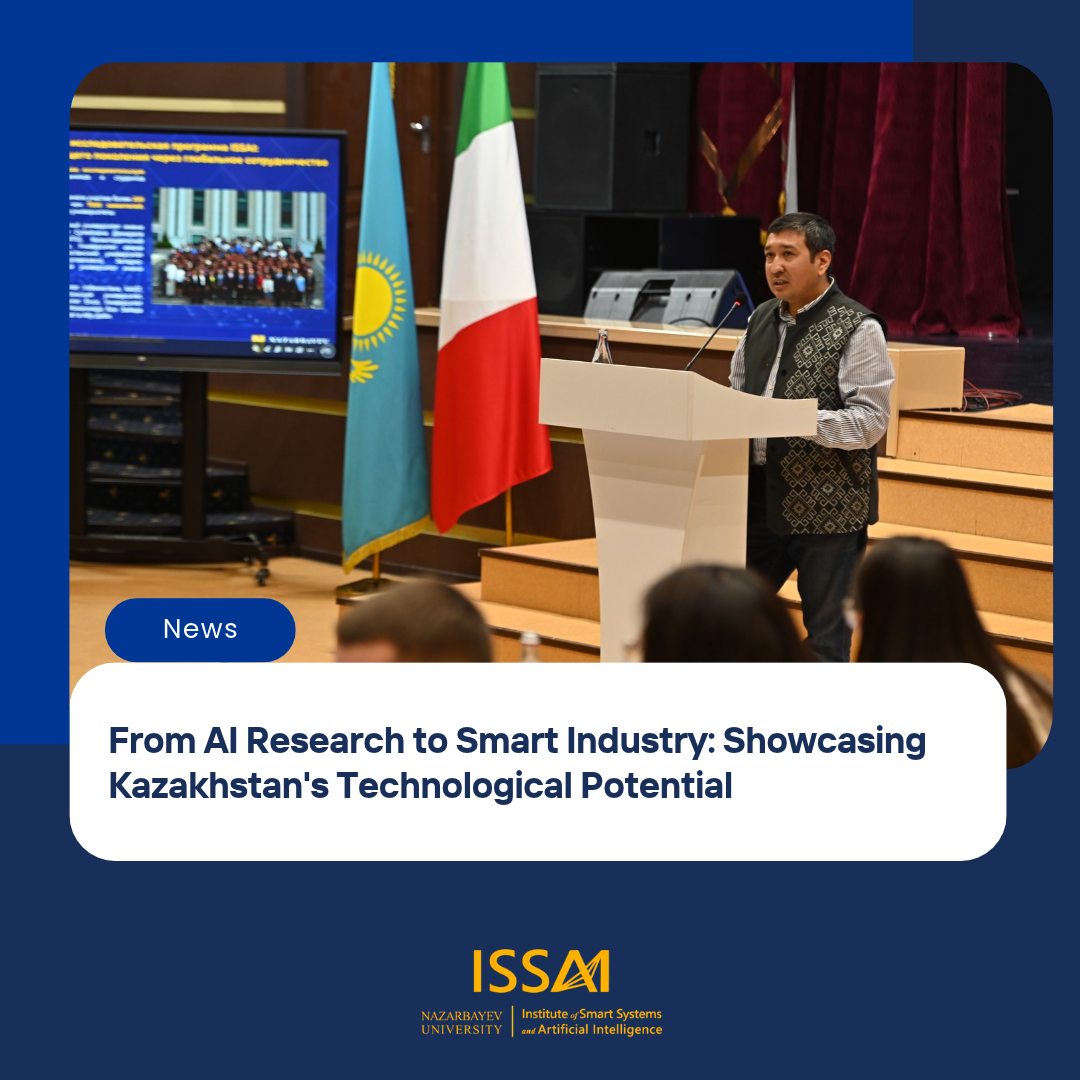
On November 16, the Kostanai Socio-Technical University named after Academician Zulkharnay Aldamzhar (KSTU) hosted an international round table titled “The Application of Digital Technologies and Artificial Intelligence in Education, Science, and Production.” The event brought together representatives of academia, government, industry, private organizations, and international experts, including delegates from the University of Naples “Parthenope” (Italy), KSTU’s strategic international partner.
Opening the event, KSTU Rector Ruslan Abdullin emphasized the importance of digital transformation and stronger cooperation between science and business amid the rapid development of artificial intelligence.
Representing the Institute of Smart Systems and Artificial Intelligence (ISSAI) at Nazarbayev University, Yerbol Absalyamov, Executive Director of ISSAI, delivered an expert presentation titled “The Role of Universities in the Development of AI in Kazakhstan.” His talk explored how universities and research institutions can bridge the gap between scientific research and practical applications, drawing on ISSAI’s research experience and collaboration with academia through the Qolda AI model.*
A key focus of the presentation was Qolda’s potential for Kazakhstan’s machinery manufacturing, industrial automation, and robotics sectors. This is particularly relevant to the Kostanai region, which hosts major industrial enterprises, including KIA, Allur, and KamlitKZ.
Designed to process and interpret visual information in the Kazakh language, Qolda can serve as a foundation for AI-powered industrial and robotic systems. Its ability to operate on edge devices makes it especially suitable for factories, warehouses, and mining facilities, where connectivity may be limited and real-time processing is essential. Future applications could enable industrial machinery and service robots to understand Kazakh-language instructions, making human-machine interaction more accessible for local operators.
The round table also featured invited representatives of the Italian academic and business communities. Among the speakers were Paolo Caputo, Professor and Senior Research Fellow at the University of Naples “Parthenope,” economic analyst and Scientific Director for Eurasian Countries at the Foundation for Cultural Leadership; Renato Passaro, Vice-Rector of the University of Naples “Parthenope,” Rector’s Delegate for University Engagement with Society and Business and Knowledge Transfer, and Professor of Economic and Management Engineering; and Ivan Spera, Chief Executive Officer of private companies WEEEGO srl, SSOLID srl, and S.G.I. srl.
ISSAI’s participation in the round table provided an opportunity to showcase Kazakhstan’s growing AI research capabilities, demonstrate the practical potential of locally developed technologies, and strengthen dialogue between science and industry.
*Qolda model – A model created by ISSAI under the grant funded by the Science Committee of the Ministry of Higher Education and Science of the Republic of Kazakhstan (program targeted funding – BR24993001), where consortium members are Al-Farabi Kazakh National University (KazNU, leader), ISSAI, Til-Qazyna Scientific-Practical Center, the A. Baitursynov Institute of Linguistics, and the Institute of Information and Computational Technologies.