


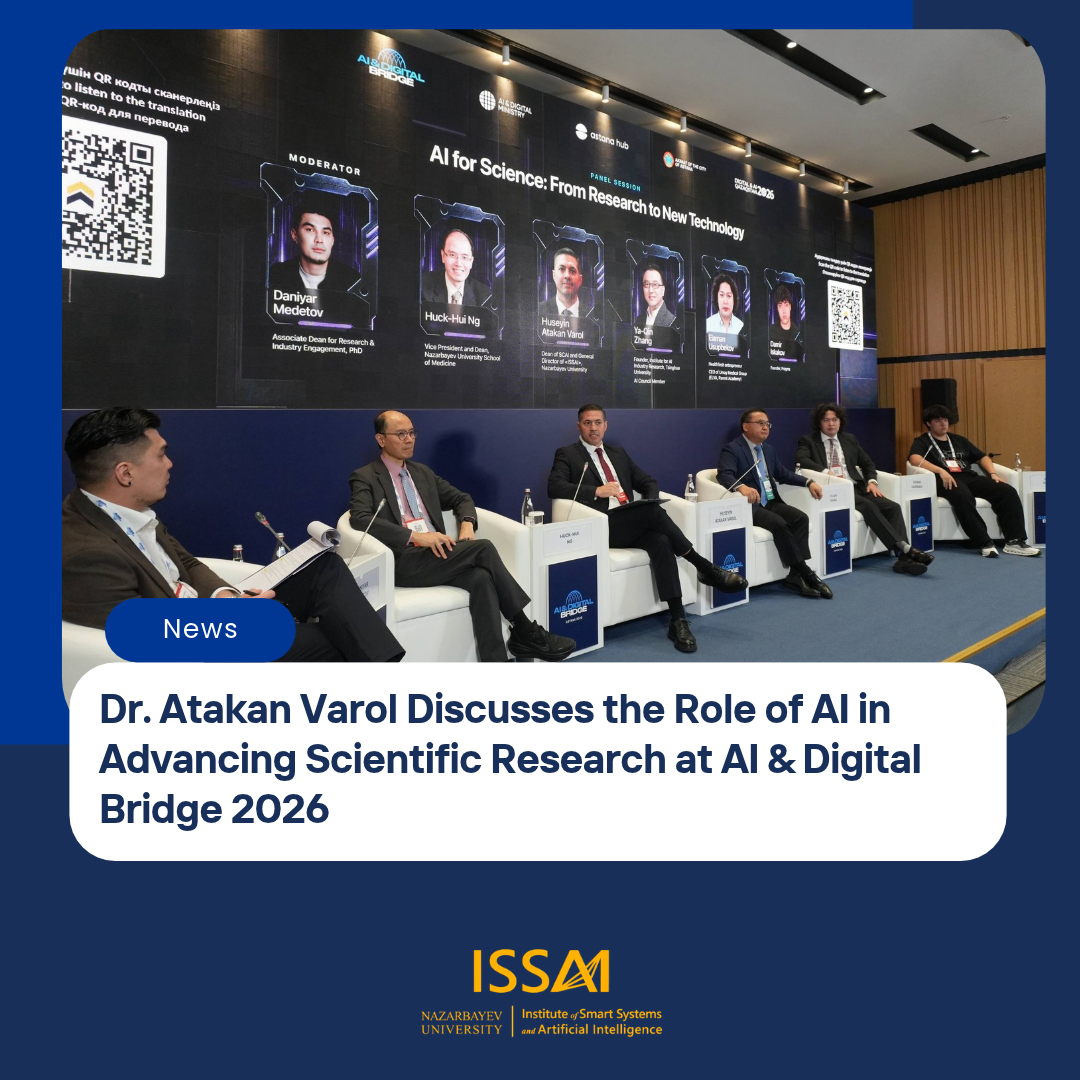
Dr. Huseyin Atakan Varol, Dean of the School of Computing and Artificial Intelligence (SCAI) and General Director of the Institute of Smart Systems and Artificial Intelligence (ISSAI) at Nazarbayev University, participated in the “AI for Science: From Research to New Technology” panel session held on October 3, 2026, as part of AI & Digital Bridge 2026.
The session was moderated by Daniyar Medetov, PhD, Associate Dean for Research & Industry Engagement. Other panelists included Huck-Hui Ng, Vice President and Dean of the Nazarbayev University School of Medicine; Ya-Qin Zhang, Founder of the Institute for AI Industry Research at Tsinghua University; Damir Iskakov, Founder of Pragma and Elaman Usupbekov, HealthTech entrepreneur and CEO of Umay Medical Group.
Dr. Atakan Varol began his contribution with a reflection inspired by physicist Werner Heisenberg: “What we observe is not nature itself, but nature exposed to our method of questioning.” He discussed how AI is changing the way researchers approach scientific questions, interpret data and understand complex phenomena, highlighting the importance of closer collaboration between AI specialists and domain scientists. He introduced the concept of the “hybrid scientist” — a professional combining AI expertise with domain knowledge — and noted SCAI’s focus on developing such interdisciplinary expertise.
Dr. Atakan Varol also emphasised the value of adapting global open-source models to local needs, including the Kazakh language, and identified mining, logistics,and fintech as areas with significant potential for AI applications in Kazakhstan. He also highlighted ISSAI’s ISSAI Playground as a platform showcasing locally developed AI products that can be further developed and transformed into AI tools for businesses and government institutions, adapting them to specific organisational needs.
The panel highlighted the importance of connecting AI research with real-world scientific and industry needs. By bringing together experts from academia, research and business, the discussion demonstrated how interdisciplinary collaboration, locally developed AI solutions and stronger university–industry partnerships can help translate advances in AI into practical technologies.