


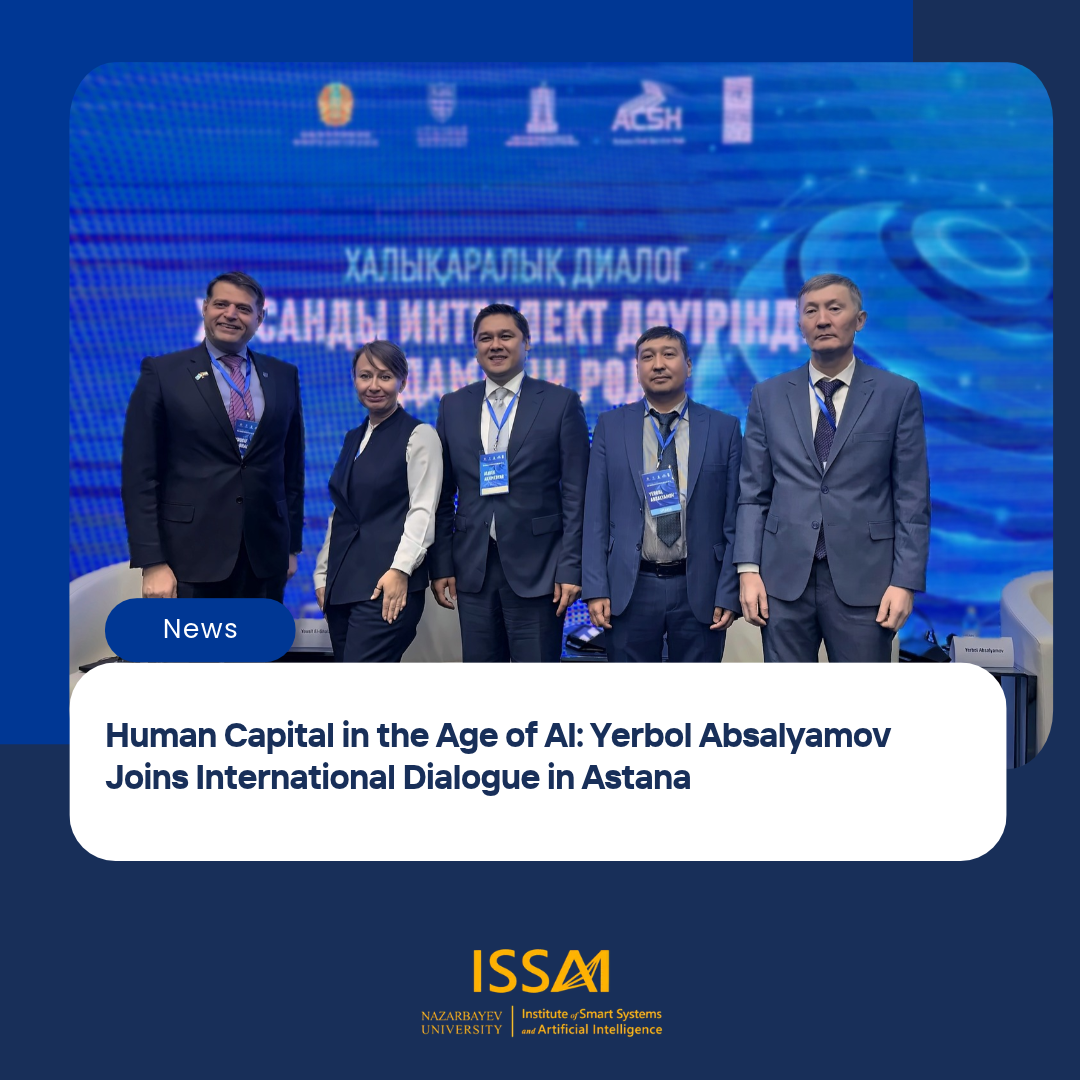
On November 27, 2026, Yerbol Absalyamov, Executive Director of the Institute of Smart Systems and Artificial Intelligence (ISSAI) at Nazarbayev University, participated in the international dialogue “The Role of Humans in the Age of Artificial Intelligence”, held in Astana.
The event marked the 10th anniversary of cooperation between the Academy of Public Administration under the President of the Republic of Kazakhstan and the Mohammed bin Rashid School of Government (MBRSG), bringing together experts and representatives from academia and public administration to explore the impact of artificial intelligence on people, institutions, and the future of work.
Yerbol Absalyamov participated in the international roundtable “HR in the Age of Artificial Intelligence”, moderated by Alibek Akhmedyar, Deputy Chairman of the Agency of the Republic of Kazakhstan for Civil Service Affairs. The session also featured Professor Yusuf El-Galayini of MBRSG (UAE), Natalia Finogenova, Head of SHL Central Asia, Hala Abdelgaffar, Assistant Professor of Human Resource Management and Organizational Behavior at KIMEP University, and Maksut Uteshev, representing the Regional Hub in the field of civil service.
In his presentation, “AI-Managed HR: Data, Algorithms, and Responsible Implementation,” Mr. Absalyamov emphasized the importance of high-quality data in developing effective AI systems, highlighting data-driven AI development as one of ISSAI’s key areas of focus. He also discussed the development of AI models capable of understanding and working across Kazakh, Russian, and English, reflecting the multilingual context in which AI technologies are increasingly being applied.
He also stressed the importance of systematically auditing and evaluating AI systems to ensure their reliability, accountability, and responsible use, particularly in processes involving decisions about people. As a practical example, he introduced ISSAI’s Oylan, an AI tool used by HR professionals, and discussed how it can support their daily work, assist employees, and help identify opportunities for professional development and skills enhancement. AI tools can thus help organizations better understand workforce needs and support employee growth while keeping human expertise at the center of decision-making.
The dialogue provided a platform for exchanging international perspectives on the opportunities and challenges of AI adoption in human resource management, from personnel assessment and organizational behavior to trust, employee experience, and responsible implementation.
ISSAI continues to contribute to the development and responsible application of artificial intelligence, with a focus on data, multilingual AI, and solutions that support people and organizations.