

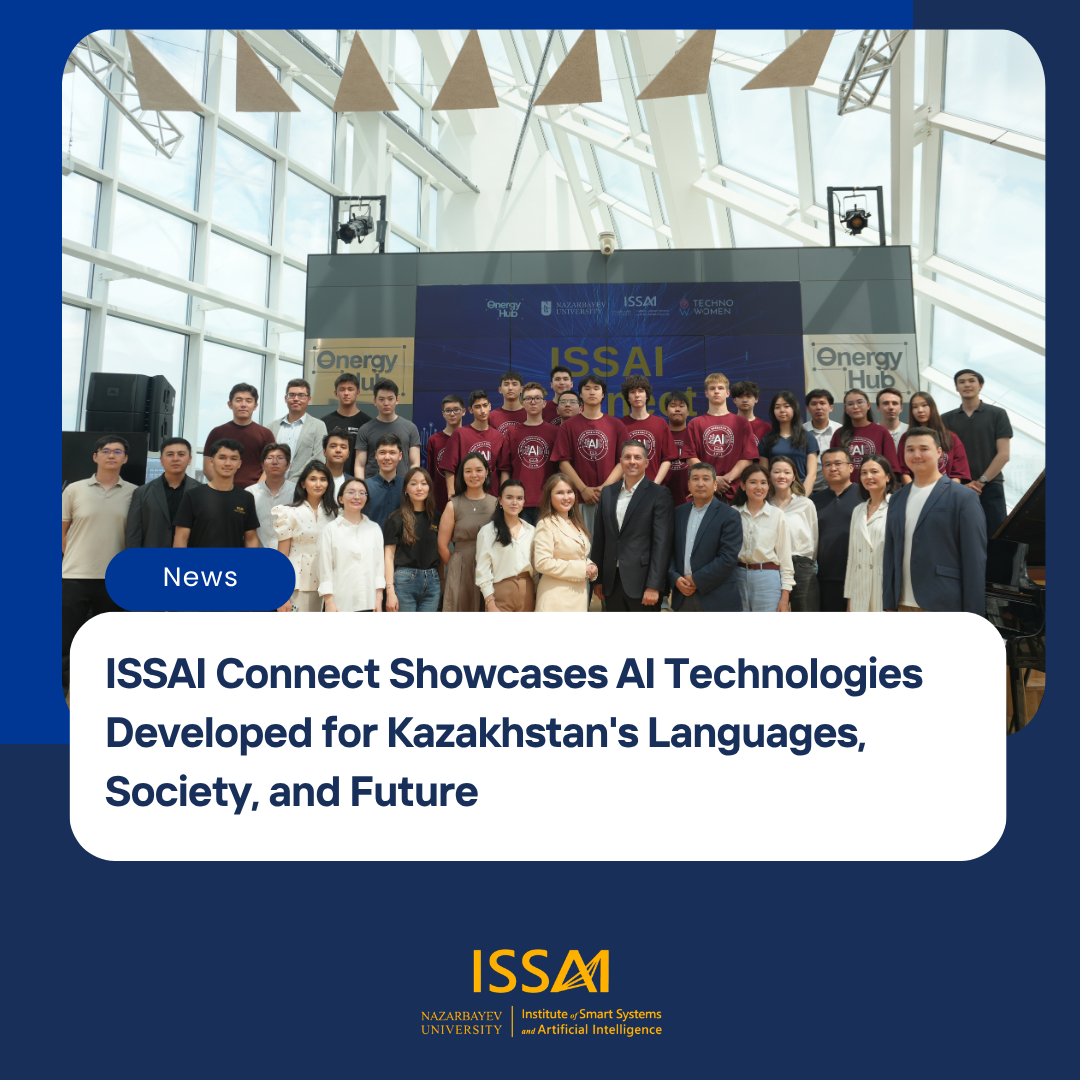
Astana, Kazakhstan — July 16, 2026 — The Institute of Smart Systems and Artificial Intelligence (ISSAI) at Nazarbayev University showcased its latest artificial intelligence technologies during ISSAI Connect, a media and partner event highlighting practical AI innovations developed in Kazakhstan. Held at the techno-creative and art-infused Өnergy Hub, a long-standing partner of ISSAI in fostering innovation and technology engagement, the event demonstrated how locally developed AI can address real-world challenges while supporting the Kazakh language and protecting data privacy.
The event brought together journalists, technology partners, researchers, government representatives, industry stakeholders, and members of the Nazarbayev University community for live demonstrations of ISSAI Voice Studio, MangiSoz App, Joldas AI, and Qolda SLMs. Guests also explored an exhibition featuring projects developed by participants of ISSAI’s Summer Research Program, providing a firsthand look at the institute’s latest research and educational initiatives.
Opening the event, ISSAI Founding Director Dr. Huseyin Atakan Varol emphasized the importance of developing artificial intelligence that reflects local languages and societal needs.
“Artificial intelligence is only truly powerful when it intimately understands the people who use it. Our mission at ISSAI is to ensure Kazakhstan’s AI models, products, and services are built from the ground up by local minds. Our team draws from the best technological exemplars around the world, applying cutting-edge research to create AI that is uniquely ours. By developing open, world-class solutions tailored to Kazakhstan’s linguistic and cultural context, we aren’t just participating in the global AI ecosystem. We are leading it on our own terms and setting a benchmark for peer nations.”
ISSAI Voice Studio: A New Generation of AI Speech Technologies
One of the flagship technologies showcased during ISSAI Connect was ISSAI Voice Studio, an integrated platform that combines AI-powered dubbing, expressive text-to-speech, speaker diarization, and advanced speech technologies.
ISSAI Voice Studio enables automatic dubbing while preserving the original speaker’s vocal characteristics and emotional expression. Its expressive speech synthesis produces natural, human-like voices, while its speaker diarization capability separates multiple speakers in real time to create structured transcripts for meetings, interviews, podcasts, and conferences.
During the showcase, journalists observed a film clip automatically dubbed into Kazakh while maintaining synchronized lip movements, natural intonation, and emotional delivery. A second demonstration illustrated real-time speaker separation, where overlapping conversations were instantly organized into individual speaker tracks, showcasing the platform’s potential for media production, content localization, and professional communications.
MangiSoz App: Breaking Language Barriers
ISSAI also presented MangiSoz App, a multilingual mobile application that enables instant speech recognition, translation, and transcription. Designed for everyday communication, meetings, conferences, and international collaboration, the application supports seamless multilingual conversations through an intuitive interface.
One of its key features is split-screen live translation, allowing two speakers using different languages to communicate naturally while each participant views the conversation in their preferred language. The application also provides automatic transcription, making it useful for journalists, researchers, students, and business professionals.
During the live demonstration, participants watched two speakers communicate naturally while the application translated their conversation in real time, illustrating how AI can simplify multilingual communication.
Joldas AI: Making the Physical World More Accessible
Another technology featured during ISSAI Connect was Joldas AI, a mobile application developed to support blind and visually impaired users. Combining computer vision and speech technologies, the application describes surrounding environments in Kazakh, helping users navigate public spaces more independently.
Using a smartphone camera, Joldas AI can recognize signs, read text, identify objects, describe surroundings, and assist users in understanding their environment through natural voice feedback.
Live demonstrations showed the application recognizing navigation signs and public information displays, highlighting its potential to improve everyday accessibility and independent mobility.
Qolda SLMs: Powerful AI That Works Offline
ISSAI also demonstrated Qolda, its family of Small Language Models (SLMs), designed to run entirely on local devices without an internet connection. Qolda is being developed within the framework of the Ministry of Higher Education and Science’s Program-Targeted Financing project, “Development of a Large Language Model (LLM) to Support the Kazakh Language and Technological Progress.”
The project is implemented by a consortium of scientific and research organizations comprising ISSAI, Al-Farabi Kazakh National University, the Institute of Information and Computational Technologies, the A. Baitursynov Institute of Linguistics, and the Sh. Shayakhmetov National Scientific and Practical Center “Til-Qazyna.”
Unlike large cloud-based language models, Qolda processes information locally, allowing organizations to analyze confidential documents while maintaining complete data privacy. Optimized for the Kazakh language and local context, it is particularly suitable for government institutions, healthcare organizations, financial institutions, and enterprises handling sensitive information.
During the demonstration, the internet connection was intentionally disabled before Qolda processed a lengthy document and generated a concise summary within seconds, illustrating how advanced AI capabilities can remain fully operational offline.
According to Amina Baikenova, Deputy Director of Product and External Affairs at ISSAI, every technology presented during the event was designed with practical adoption in mind.
“Our goal is to develop AI products that solve real problems rather than showcase technology for its own sake. Whether helping visually impaired citizens navigate independently, enabling secure document processing without internet access, making multilingual communication effortless, or expanding high-quality Kazakh-language media, these solutions demonstrate how AI can become a practical tool that improves everyday life.”
Beyond showcasing AI technologies, ISSAI Connect highlighted the institute’s commitment to developing the next generation of AI researchers. Since 2021, ISSAI has organized its annual Summer Research Program (SRP), welcoming university and high school students from Kazakhstan and abroad to work alongside ISSAI researchers on cutting-edge artificial intelligence projects. During this year’s event, SRP participants presented research prototypes and AI applications developed under the guidance of ISSAI mentors, giving visitors an opportunity to meet the young researchers helping shape the future of AI in Kazakhstan.
Throughout the event, guests explored interactive demonstration stations, tested the showcased technologies firsthand, met the researchers behind the innovations, and engaged with students presenting their Summer Research Program projects.
By developing AI systems specifically optimized for Kazakhstan’s linguistic and technological landscape while investing in future AI talent, ISSAI continues its mission of advancing sovereign artificial intelligence and contributing open technologies to the global research community.